
Hybrid App Development
Why Choose a Hybrid App?
A Hybrid app has distinctive features in its programming suite. Hybrid apps are built using technologies that utilise web programming and frameworks yet they have a Native app appearance, this is mainly due to a Hybrid app being wrapped up in a Native app outer shell.
Thus, a Hybrid app has a competitive advantage over other applications as its web database is not limited to accessing a single mobile operating system lending itself to Google Android & Apple iOS.
It sounds a lot like a Progressive Web App doesn't it? Unsurprisingly, there are differences which we'll explain below.
Similar to a PWA, a Hybrid app is also written by web programming code, such as HTML, JavaScript, and CSS (Cascading Style Sheets), however, a unique feature only PWA has is, although shares the aforementioned commonality, a PWA is still a website with a superhero app cape on. This means you can turn most of your website into a PWA in a short amount of time. A Hybrid app contains more features that are native to the operating systems and platforms it sits on. Also, Apple iOS recognise Hybrid apps as Native apps due to their native shell and can be dismissive of PWA's from an app store perspective.
Let's also give careful consideration to other attributes:
Easy to scale and manage
- Hybrid apps use a singular codebase which allows them to be deployed across devices. For example, when you build a Hybrid app for Android, you can easily launch the same app on iOS. Unlike with native building where you have to create two apps, with hybrid software building, you only have to develop a single app meaning you're only required to administer and manage one database
Quicker to expedite
- Very simply put, a Hybrid app only has one database to manage, it's quicker to build a Hybrid app than a Native app so both lead times and costs are less
Performance
- Native apps are developed in languages that are fully supported by the platform’s ecosystems, hence, they have the ability to run faster than non-native apps. You can also access a Hybrid app offline, you may not get the very latest updated information but you can cater for those whose internet connectivity is a challenge
Easy maintenance
- Hybrid apps offer simplified maintenance. Native apps require new versions for every platform with each update. A Hybrid app eliminates the need for versioning and makes app management straightforward

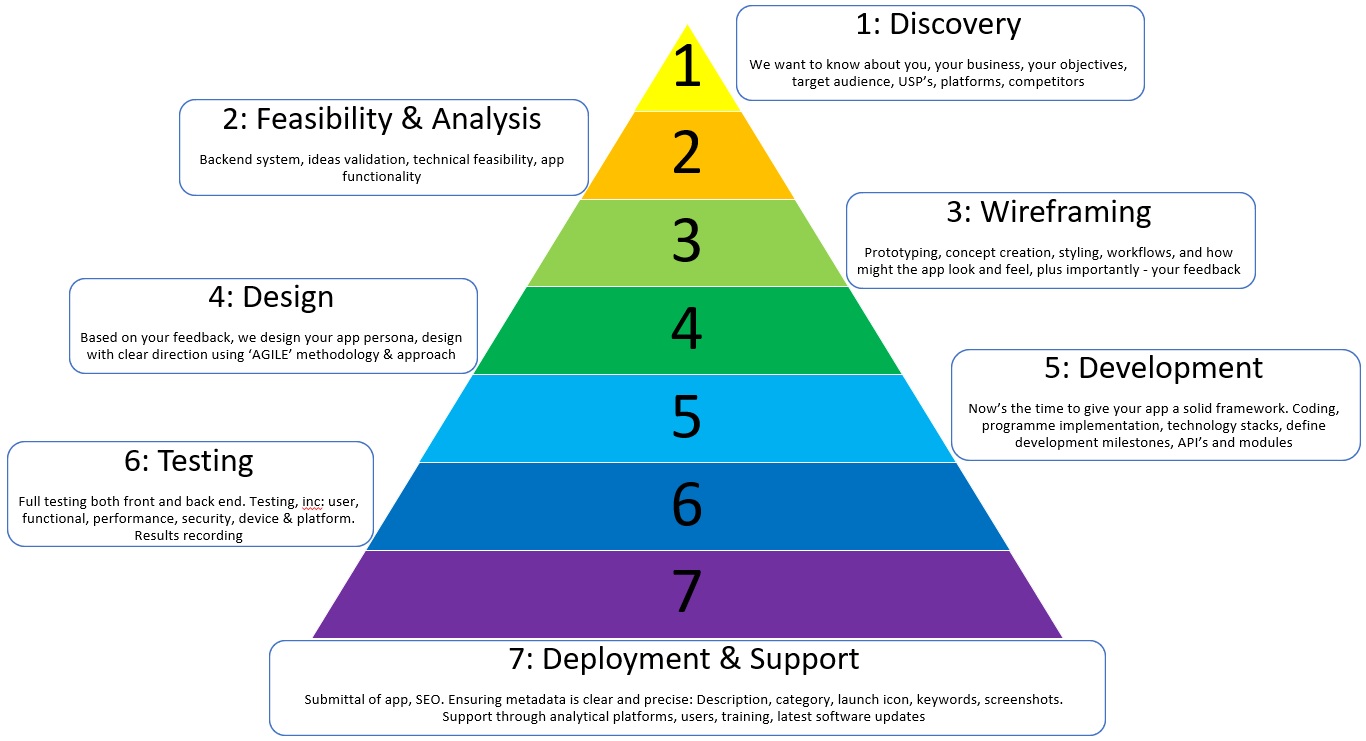
7 Stage App Development Process
Why IoTech?
We are wholeheartedly customer-centric, putting you, our customer, at the core of our business and firmly in the driving seat. We are focussed on providing unrivalled, positive customer experience
We provide complete end-to-end, turnkey mobile app development services. Exceptional user experience is our ultimate goal whilst transforming your idea into reality
Multiple App Options - Mobile to Web

A Progressive Web App, or PWA for short, is a Web based app but performs like a Native app by combining the best of both worlds. They are also searchable via engines like Google so have huge SEO advantages
Native apps but ONLY for Googles Android users. The platform is free and offers easy availability of the Android SDK (software development kit). Being open source, development costs are lower than iOS
A Web app runs in a web browser and are delivered to users on the World Wide Web with active network connections. There is no need to install a Web app which also utilises SaaS (software as a service) technology
Native apps but ONLY for Apple iOS users. Easy to use with simple interfaces, plus, security is a top priority with high data encryption
Hybrid apps are built with web technologies (HTML, CSS, and JavaScript) but allow access to platform features that a browser can’t provide. They are essentially Web apps but wrapped up to look like Native apps
IoT apps run on IoT devices which consist of sensors/devices which communicate with the cloud through a plethora of methods and connectivity. IoT apps can be created to be specific to almost every industry and vertical, including healthcare, industrial automation, smart homes and buildings, smart cities, Industry 4.0, automotive, and wearable technology to name but a few
Despite similarities in appearance and design, the underlying technologies are quite different from Web apps, PWAs, or Hybrid apps. Native apps are developed for specific operating systems, mainly Android & iOS so can't be accessed via an internet browser. Speed is key here! Native apps are traditionally very fast!