
24 Aug Will Industry 5.0 replace Industry 4.0

industry 5.0
Will Industry 5.0 replace Industry 4.0?
Is industry 4.0 obsolete? Shall we now be focussing on Industry 5.0?
Firstly, let’s understand the fundamental differences between Industry 4.0 and Industry 5.0
Industry 4.0 refers to the fourth industrial revolution. Sometimes known as IIOT which is short for Industrial Internet of Things, Industry 4.0 essentially combines physical production and operations with smart digital technology allowing for machine learning and big data to create a more comprehensive and extensive way of marrying connected ecosystems within both manufacturing and supply chains.
Industry 4.0 is not solely concentrated on new technology investment that in turn improve manufacturing efficiency it’s about transforming the way your entire business operates and expands above and beyond the limitations of manually operated machines.
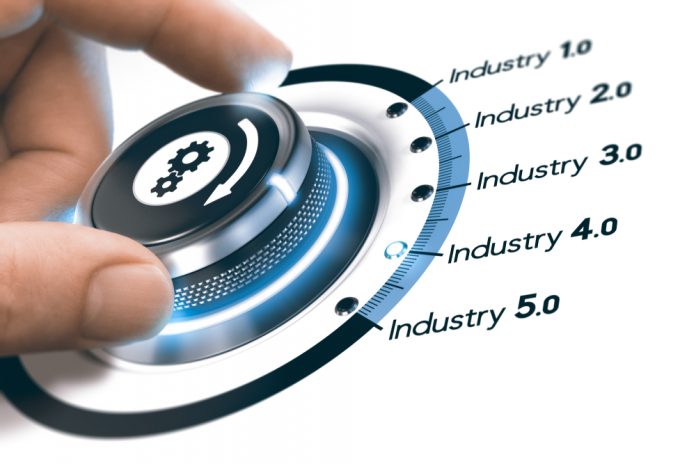
To help you visualise the evolution of these stages, IoTech has introduced a short summary of these changes below showing the fundamental difference in these 5 industrial revolutions:
Industry 1.0 (1750)
Let us look at an early example in the textile industry from 1733. John Kay invented the fly shuttle. This dramatically increased both the quality of production from a single weaver and the speed at which it could weave. Around the 1750s further advancements took place when manual tasks such as towing a plough, manual weaving or using picks for mining coal entered stages of automation by through the use of water, steam and coal.
In 1764, the steam engine, arguably invented by Thomas Savery was put to better use when James Watt industrialised the use of the steam engines by inventing an efficient and powerful means of circular motion that could effectively power a wheel. This invention became the basis for larger-scale factories that defined the Industrial Revolution. Watt’s steam engines replaced muscle power on a very large scale.
Industry 2.0 (1850-1914)
Building upon the inventions of the 18th century allowed further application of automated machinery. Note the word ‘Steel’ & ‘Electricity’. Yes, steel had been used for many centuries prior to the aforementioned dates but only on a small scale, however, the Bessemer process brought about an inexpensive industrial process for the mass production of steel by the use of pear-shaped receptacle—referred to as a ‘converter’ in which iron could be heated, impurities removed allowing for the construction of endless miles of railroad tracks which revolutionised the transportation industry.
Batteries were invented in 1800 and crude oil was discovered in 1875. This eventually led to the invention of the internal combustion engine which revolutionised the mass production of the automobile.
Industry 3.0 (1940-2010)
Now we start to look at modern-day automation which arguably started as early as 1940’s with the first electric programmable computer called ‘The Colossus’. The Colossus played a crucial role in deciphering Germanys Lorenz messages during World War 2. Many, however, see the 1970’s as being the milestone, mainly because this is when computer technologies entered factories. Computer technology allowed for a shift in working practices placing less emphasis on analog and mechanical technology and more on digital technology. Automation software also in the form of robotics were introduced. The introduction of robotics into the industrial workplace automated a significant proportion of human’s workload. While humans need rest and sleep, robotics allowed for increased productivity especially in the case of repetitive tasks, allowing factories to operate longer hours on almost a 24/7 basis.
Industry 4.0 (2011-today) The Domino Effect
In Industry 3.0, automated technologies continued to progress, often operating largely without human interference, but still requiring some forms of human interventions. For example, an Industry 3.0 pick and place machine for PCB population, whilst largely automated, still needs input from a human controller to operate. Whilst the process is automated this is reliant on human input, and not software. Under Industry 4.0, that same pick and place machine is not only able to follow set programming parameters but also use data to streamline production processes.
The fourth industrial revolution (Industry 4.0) is further proof of this domino effect by taking what was started in the previous industrial revolution and directly influencing the next advancement. We’ve now taken computers and automation and enhanced it with smart and autonomous systems fuelled by data and machine learning.
The current trend of automation and data exchange in manufacturing technologies, including cyber-physical systems, cloud computing, the Internet of things including smart cities, agriculture, aquaculture, maritime (the list continues) now make the best use of current technologies introducing cognitive computing and creating the smart factory.
Industry 4.0 creates the use of manufacturing systems, whereby machines in factories are augmented with wireless connectivity and sensors which monitor entire production processes and make autonomous decisions. More recently the 5G technology, is providing ultra-low latency allowing for near real-time communication between a multitude of systems. Viewing entire industrial processes remotely from various apps and robustly test automated environments to make cost-effective decentralised decisions.
To break this down further, industry 4.0 brings:
- The Internet of Things (IoT)
- The industrial internet of things (IIoT)
- Cyber-physical systems (CPS)
- Smart manufacture
- Smart Devices
- Smart Factories
- Cloud computing
- Cognitive computing
- Artificial intelligence (AI)
Industry 5.0 (2020 and beyond)
Industry 5.0 brings the dawn of a new digital age. You can say that industry 5.0 is the re-humanisation of automation where robotic, automated and digital advances meet human intervention and collaboration. This is a human-centric interface that concentrates on decisions surrounding how people can, need and want to perform tasks rather than having to accommodate every flavour of robotic process placed before them, you could call it ‘The collaboration between increasingly powerful AI machinery and the unique creative potential of the human being”
The revolutions can be summarised as follows:
1st industrial revolution – Steam and water power are used to mechanise production
2nd industrial revolution – Electricity allows for mass production with assembly lines
3rd industrial revolution – IT and computer technology are used to automate processes
4th industrial revolution (Industry 4.0) – Enhancing automation and connectivity through computation
5th industrial revolution (Industry 5.0) – IS NOT Human vs Machine but Harmonisation of humans and machines
The Big Question: Will Industry 5.0 replace Industry 4.0?
The short answer is no, let’s explore deeper and discover why.
We’re by no means switching off the digital innovation that smart machines do and can offer but reversing the mindset in order to meet more cost-effective, efficient and effective ways of working. The thinking behind Industry 5.0 is to use and benefit people using the technologies built-in Industry 4.0 to make better decisions for a brighter future. We’re all accustomed to machines in the workplace become smarter, Industry 5.0 focuses on merging those cognitive computing capabilities with human intelligence and resourcefulness in collaborative operations.
The days of believing that workers come second place to the machine are unfounded and simply not true. While robots are more consistent in precision working they lack the ability of adaptable, critical thinking which define us as humans. Robotics are in place to provide assistance whereas industry 5.0. defines the gap of optical balance, efficiency and production.
Gone is the hypothesis of whether AI, Robotics, automation from Industry 4.0 can or can’t work with humans, but how they can best leverage smart technologies to drive optimal outcomes from human/machine interactions.
Sorry, the comment form is closed at this time.